Hardware

An 8-layer, 2.4-gram sensor board

The sensor board was designed from the ground up for animal-borne deployment: small, light, cheap to produce, and efficient enough to run for months on a single battery.
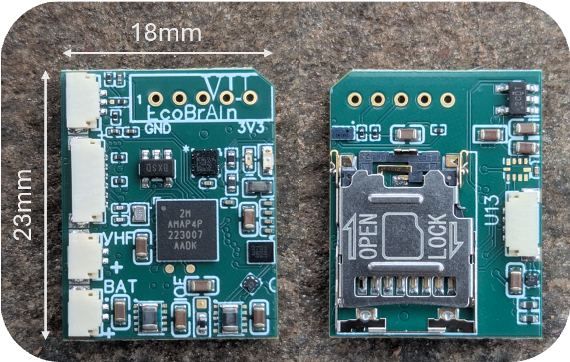
The A3EM animal-borne acoustic sensor board hardware

18 × 23 mm

PCB footprint, 8-layer board

2.4 g

Board weight — light enough for small animals

~$100–130

Per-board cost (excludes SD card and enclosure)

3.6 V

Battery input, multi-stage regulation to 1.8 V core

SpecA3EM Sensor BoardAudioMoth (reference)
MCUAmbiq Apollo4 PlusARM Cortex-M0+
Clock speed96–192 MHz (~4 µA/MHz)48 MHz (~62 µA/MHz)
Non-volatile memory~2 MB MRAM (~8x)256 KB Flash
RAM~2.75 MB (~85x)32 KB SRAM

The Apollo4 Plus's DSP instructions and integrated low-power audio ADC — with a programmable gain array spanning 0–24 dB — make it well suited to real-time audio analysis while sipping power. The board supports analog electret, analog MEMS, and digital PDM microphones, an onboard ADXL345 IMU and magnetic sensor for activation, an external GPS-collar header, and control of an external actuator such as a VHF transmitter.

2026 update — moving to digital microphones. Field deployments on bighorn sheep and caribou surfaced a cold-temperature artifact (crackling, static, aliasing below roughly 5–10°C) traced to instability in the Ambiq MCU's analog front end — not something firmware could fully correct. Digital PDM microphones (10–10,000 Hz response) eliminated the artifact in freezer testing and improved signal-to-noise even at ~30 dB of gain. A 3D-printed microphone holder sandwiching a Gore acoustic vent and waterproof foam, plus a chamfered port, steel-mesh cover, and open-cell foam plug, keep the digital mic protected and wind noise down. The analog path remains fully supported.
Firmware

Configurable in the field, by researchers of any skill level

Firmware configuration is deliberately three-tiered so that a field researcher — not just a firmware engineer — can provision a device correctly.

1. Base firmware

Full configuration support compiled into flash memory on the device.

2. Runtime config file

An editable, human-readable configuration file on the SD card used for data storage.

3. Graphical dashboard

A configuration dashboard so researchers can provision devices without hand-editing text files.

Configuration options

  • Device ID
  • GPS availability
  • Status LED active time
  • Microphone type & gain
  • Magnetic activation settings
  • Deployment schedule & phases
  • RTC time alignment
  • VHF beacon settings
  • Audio clip properties
  • Recording mode — continuous, schedule, interval, threshold, or intelligent
  • IMU recording settings

Power optimization (2026)

Firmware work this period acted directly on the finding from our published paper that SD-card writes dominate the power budget, batching and time-aligning writes and combining audio, log, and IMU writes into single SD wake-ups.

ConfigurationBaseline currentOptimized currentReduction
Continuous recording (LEDs off)7.878 mA
8 kHz audio + 50 Hz IMU, 60s clips2.08 mA~3.8x
16 kHz audio + IMU2.13 mA~3.7x
Low-power listening mode~1.5 mA>5x
Deep-sleep / magnet-wait~0.5 mA~300 µA~1.7x

With a digital microphone and a 7,000 mAh pack, the deployment-planning model now estimates ~158 days of battery life for uncompressed 8 kHz audio — at which point a 128 GB SD card (~95 days) becomes the limiting factor rather than the battery. Embedded OGG Opus compression extends storage to roughly 600 days at 16 kbps while keeping battery life above ~120 days, and devices are now routinely paired with 256–512 GB cards. An optional silence/relevance filter adds further headroom, saving up to ~75% under favorable thresholds.

Adaptive Data Collection & Embedded ML

Deciding what's worth keeping, on the device, in real time In Progress

Continuous recording is simple but wasteful: it depletes power and storage quickly and leaves the hard work of finding meaningful events to offline post-processing. A3EM instead performs in-situ relevance assessment using lightweight, low-power, fully unsupervised learning.

This work is ongoing: the current field workflow relies on post-deployment processing — audio is recorded continuously and then filtered, classified, and annotated after the device is recovered — while the on-device, real-time capabilities below are actively being developed and validated.

Variational autoencoder + online clustering

Incoming audio is downsampled, segmented, and reduced to a compact latent representation by a convolutional VAE optimized for embedded deployment. A quantized version of the model occupies just 24 KB — small enough for a resource-constrained microcontroller. An online clustering algorithm then compares each new embedding against a fixed-size set of cluster centers to flag novel, information-rich segments for retention while discarding redundant ones.

Validated in simulation

A custom simulation environment replayed manually labeled clips (urban recordings and ecological sound databases) across 24-hour and 7-day virtual deployments with deliberately imbalanced event classes. Both the full and quantized VAE pipelines achieved near-equal representation of all classes in the filtered output — successfully surfacing rare events — outperforming simpler spectral-flux and RMS/zero-crossing-rate heuristics, which remain useful lower-power fallbacks where filtering precision can be traded for efficiency.

Elephant rumble filter

A frequency-windowed RMS thresholding filter, tuned via threshold sweeps against the retention/power trade-off, achieved roughly 98–99% precision and 75–85% recall on animal-borne elephant rumble data in manual validation.

On-device classification

A compressed (~500 KB) YAMNet-derived classifier runs in real time on the Apollo4, and inference is migrating from TensorFlow Lite Micro toward ARM CMSIS primitives. Since firmware power savings now make continuous recording far cheaper, on-device classification is increasingly aimed at post-deployment filtering and auto-annotation rather than in-field power savings.

Code-free classifier workflow

A prototype workflow built around the BirdNET Analyzer GUI and Raven Pro metadata conventions lets domain scientists create and refine custom classifiers without writing code — the practical embodiment of the semi-supervised learning goal.

Anti-poaching gunshot detection

A multi-microphone gunshot-detection experiment showed the board and its digital microphones capturing gunshot signatures comparably to a reference microphone — a promising direction for anti-poaching applications.