NSF Cyber-Physical Systems Project

Real-time acoustic monitoring, carried by the animals themselves.

A3EM (Animal-Borne Adaptive Acoustic Environmental Monitoring) is a low-power, machine-learning-enabled sensor platform that rides on wild and captive animals to observe their environment and behavior — adapting in real time to what it hears instead of just recording everything and sorting it out later.

7
Species Instrumented
3
Continents in the Field
7
Open-Source Repositories
~158
Max Days per Deployment
The Problem

Static recorders can't keep up with wild animals.

Most acoustic wildlife monitoring today relies on stationary recorders and offline processing after the fact — an approach that doesn't scale, can't react in real time, and often exhausts battery and storage long before it captures the events that matter. A3EM instead puts a small, adaptive, machine-learning-capable sensor directly on the animal, so the system can learn what's worth keeping as it happens.

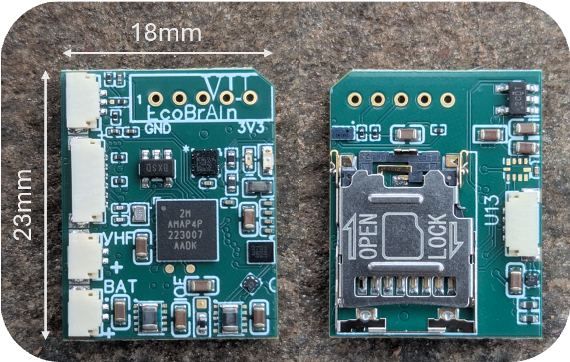
The A3EM animal-borne acoustic sensor board
The A3EM sensor board — a small, adaptive sensor worn by the animal.
Project Goals

Six goals we're building toward

A3EM is an ambitious effort to bring embedded machine learning, resource-aware firmware, and field-tested hardware together into a platform that makes animal-borne acoustic sensing practical at scale. These six goals define what we hope to achieve by the end of the project — much of it still ahead of us.

1

Dynamic Sensing Infrastructure

We aim to build embedded ML that learns and classifies acoustic events in real time on the animal itself — adapting to new and unexpected sounds rather than relying on predefined event types.

2

Semi-Supervised Learning Interface

We envision tools that let domain experts validate, relabel, and give feedback on system performance, continuously improving the network without exhaustive pre-labeling.

3

Resource-Efficient Embedded ML

We're pursuing model compression and quantization efficient enough for deep learning models to run for months on a coin-sized power budget aboard a wearable device.

4

Adaptive Data Collection

We're working toward multi-objective optimization that decides what to store, transmit, or discard based on event importance, remaining power, storage, and network availability.

5

Prototype & Field Testing

A working hardware/firmware prototype, refined through real-world use — with field testing already underway across seven species on three continents.

6

High School Curriculum

We hope to develop a NetsBlox-based summer camp curriculum that introduces programming through wildlife conservation technology, broadening participation in STEM.
Recent Progress

What's new

Digital microphones & a 3.8x power cut

The platform moved to digital PDM microphones after tracing a cold-weather recording artifact to the analog front end, and firmware optimization cut average current from 7.9 mA to roughly 2.1 mA — shifting the deployment limit from battery life to SD card capacity.

First-ever forest elephant deployment

Alongside ongoing savanna elephant, bighorn sheep, and caribou work, the project added first-time deployments on forest elephants with the World Wildlife Fund (Central African Republic) and brand-new collaborations on brown bear with the Scandinavian Brown Bear Research Project (Sweden) and white-lipped peccary with Osa Conservation (Costa Rica).

Published system paper

"Animal-Borne Adaptive Acoustic Monitoring" appeared in the Journal of Sensor and Actuator Networks (2025), detailing the hardware, firmware, and unsupervised adaptive-filtering approach. See publications →

International outreach

A week-long acoustic monitoring workshop for 53 participants in Thailand, plus a second Nashville high school summer camp, and a funded WildLabs proposal to bring the platform to a broader community of ecologists.